
Rotations 101: Advice for Incoming Biochemistry Graduate Students
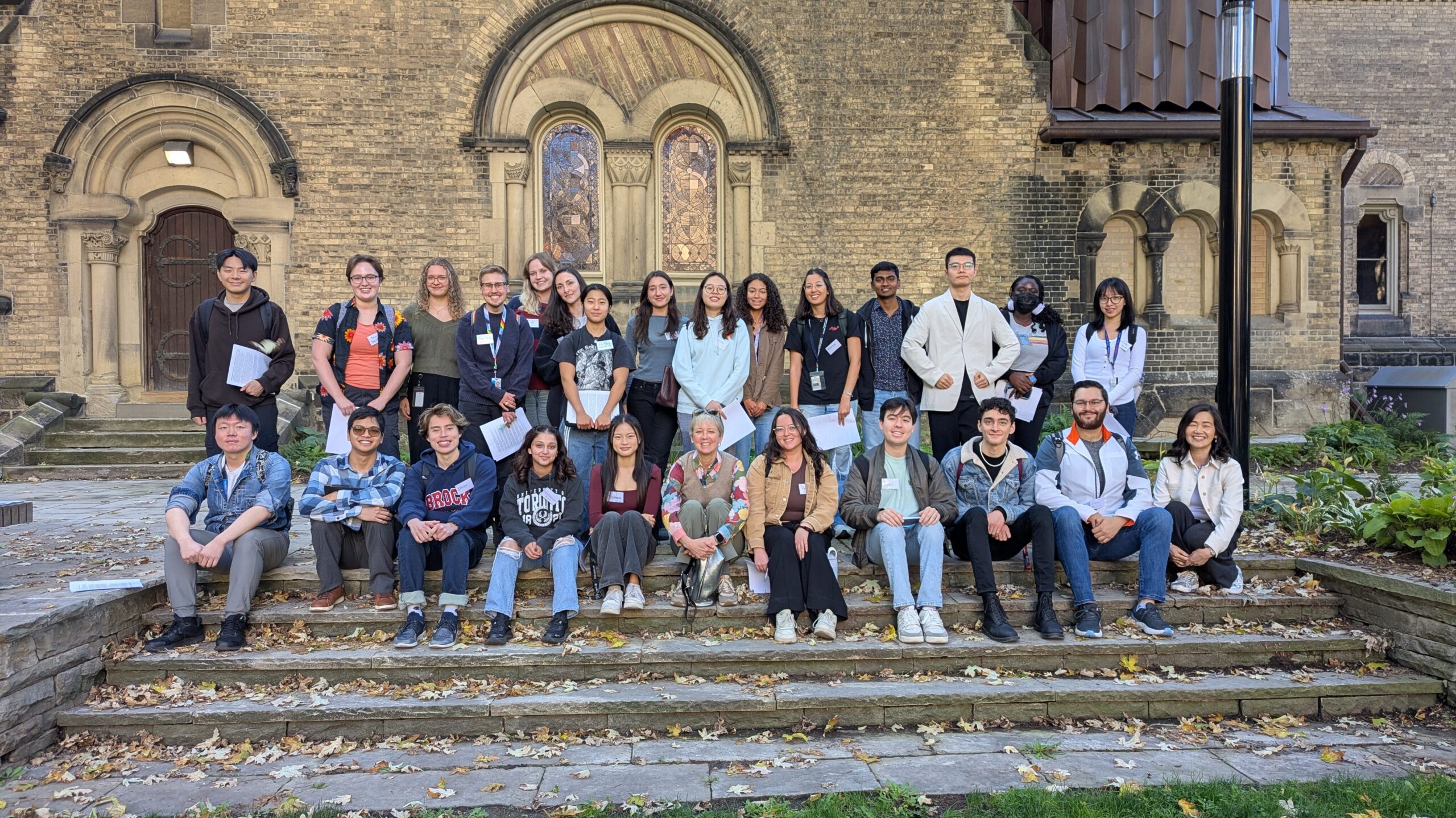
Header image: BCH2101 class of 2025
Written by Raabez Ahmad and Renee Jing
You’ve made it! Welcome to the Department of Biochemistry at the University of Toronto. If you’re feeling a bit of anxiety and uncertainty, fear not – this is a completely normal response to any new environment. To help alleviate some of this uncertainty, Transcripts teamed up with Dr. Haley Wyatt (The Biochemistry Graduate Coordinator at the time this interview was conducted) to address some of your most pressing questions about the rotation system. Our hope is that this resource will help you successfully navigate through your rotations and find the best lab placement for your thesis. Graduate school is about creating your own opportunities to develop research expertise in a particular area, as well as to develop higher level professional skills in critical thinking, problem solving, time management, and communication. Another important element of the rotation system is self-reflection – in your search for the right lab, try to answer whether the scientific theme, lab culture, and supervisory styles are aligned with your individual needs for success.

Before Rotations
Raabez: Thank you again, Haley, for agreeing to sit down and chat with us. We are very excited to be providing a nice resource that can be used by incoming students for years to come. It is our hope that, along with the department’s own information, our conversation today may help make sense of this confusing process known as rotations. Do you have any advice for incoming students in the months before they’ve started their graduate program here in the Biochemistry Department?
Haley: The Graduate Office will provide you with a list of labs that are interested in recruiting graduate students (availability is based on several factors, including research funding, team size, project availability, etc.). You can research these labs online and read a few of their publications to gain a better understanding of their research focus. You are welcome to contact the lab head and request a meeting to discuss your interests further.
It’s never too early to reach out to potential supervisors. However, the Graduate Office has specific timelines that must be followed before confirming rotation placements.
As you look into labs, you may find some labs interesting due to their expertise in a specific technique (such as structural techniques like X-ray crystallography or cryo-EM, biophysical techniques, advanced light microscopy, mouse work, organoid work). Alternatively, you may find some labs that are interesting due to their expertise in a specific biological field (e.g. structural biology, molecular biology, cancer biology). It’s important to cast a wide net of interests, as nothing is finalized at the stage of rotations, so having multiple labs per interest (technical or biological) would be a good idea.
Renee: After being accepted to the program, students are given a list of supervisors taking on rotation students. What general advice would you give to students about reaching out to potential rotation labs? When should they start reaching out and how many labs should they contact?
Haley: It is never too soon to contact potential supervisors – it takes time for people to read and respond to emails, and even more time to set up a meeting. I recommend emailing potential supervisors in the first week of your rotation. You should contact at least 3 labs per rotation to ensure that you are casting a wide net (in case Plan A doesn’t work out). We also encourage students to contact potential supervisors before the start of the first rotation.
After your initial meeting, don’t be afraid to maintain contact (email, meetings) throughout the entire rotation period if interest is still relevant. Don’t forget to thank PIs for the meeting even if you don’t end up rotating in their lab – this helps to maintain a good impression (it’s always possible that they’ll end up on your committee in the future!).

During Rotations
Raabez: What are the departmental guidelines for choosing a 2nd and 3rd rotation, and choosing a lab to pursue thesis studies in? And what can we, as students, do if a professor asks us to make decisions earlier than stated in the departmental guidelines?
Haley: That is a great question. To maintain an equitable and transparent process for all students and faculty, we have adopted clear expectations regarding the timing of lab commitments and the nature of communication during the rotation period. These guidelines are consistent with practices at other research-intensive institutions and are intended to prevent early commitments, which can lead to unequal opportunities and undermine the value of the rotation experience.
The guidelines will also be discussed during the first-week orientation session and revisited in BCH2101H throughout the semester. During rotation 3, the Graduate Coordinator will also meet with the first-year students to discuss the guidelines and etiquette for finalizing a thesis supervisor.
If you feel pressured to commit earlier than departmental guidelines, you should first remind the PI of the departmental guidelines and deadlines and state that you’ll be able to provide your answer within the set timeframe. Give the PI the benefit of the doubt, as they may have just forgotten about the specific dates – as they change year to year.
If you need more individualized support, please do not hesitate to contact one of the Graduate Coordinators, our Graduate Administrator Carrie Harber, or another trusted faculty member for advice. Part of the Graduate Coordinator’s role is to navigate and resolve these situations in a professional manner.
Renee: It seems like some labs will have projects that are more suited for PhD students and some that are more suited for MSc students. Would you encourage rotation students, specifically MSc students who haven’t committed to transferring to the PhD program, to discuss this matter with potential PIs?
Haley: One important goal of the rotation program is to ensure that the needs and expectations of students and supervisors are aligned. This definitely includes situations where one or both parties have a clear preference for MSc or PhD projects. While students are not required to disclose this information, it is useful to have this conversation as early as possible so that you can pick the lab that provides the best opportunities for your success. That said, it’s OK if you haven’t decided firmly on whether you want to pursue an MSc or PhD.
Raabez: What advice would you give to rotation students who may feel disengaged, whether due to limited interest in the project or difficulty adapting to the lab’s culture? How can they remain fully committed and give their best effort, even if the placement feels like a mismatch?
Haley: That is an excellent question. You’re not alone, this experience may be more common than you think. Even if the fit isn’t ideal, it’s important to remember that the rotation is a professional experience (not a “trial run” to coast through). Rotations are opportunities for learning, networking, exposure, andprofessional development.
Here are a few guiding ideas:
1. Make it your goal to learn something. Whether it’s a new technique, literature review habits, data interpretation mindset and visualization methods, how lab meetings work, or how to ask questions and interact with lab members. All of these skills and connections will carry into the rest of your graduate career, regardless of the lab that you join.
2. Stay committed. Even if it’s not “your dream project,” this is a five-week professional experience. Show up, ask questions, meet deadlines, and proactively contribute where you can. These behaviors matter and reflect on you.
3. Use the experience to refine your “fit” criteria. One of the key aims of a rotation is to determine how well you work with a given supervisor, research team and environment. If you discover aspects that don’t feel right, that’s useful data. You’ll be better prepared for your next rotation and your eventual choice of thesis lab.
4. Remember the bigger picture. The rotation is part of your professional development, including exposure, networking, and developing self-awareness.
If at any point you’re unsure how to make your rotation more meaningful, please feel free to drop by for a quick check-in. I’m happy to help you identify one or two “next steps” to make the most of these five weeks.
Renee: On the topic of taking full advantage of rotations, how can students make the most out of their time with their senior graduate student or postdoc mentors? Beyond learning new techniques and scientific knowledge, what broader insights can I seek from them?
Haley: Your time with senior graduate students and postdocs is a valuable chance to learn how research careers work for different types of people. Ask them about their approaches to experimental design, troubleshooting, time management, and scientific writing. Learn how they think about mentorship, collaboration, and balancing research with coursework or teaching. You can also seek insights into lab culture, expectations for independence, and how they chose their projects. You may also want to learn about their leadership experiences and community involvement outside of the lab.
Raabez: I would also say that it can be useful to ask graduate students about their previous rotation experiences (what did they like and not like about those labs? Why did they end up choosing their current lab?).
Renee: I can imagine that there are many ways to learn about a potential lab. In your experience, where are the best places to gather information to get the most accurate picture of what a lab is really like?
Haley: If you are seeking information about a given lab culture or potential supervisor, seek information from your PI and current lab members, past lab members (if possible), students that rotated through the lab, and other faculty (including collaborators or lab neighbors). For example, if you are thinking about going into a certain field after graduation (e.g. industry or academia) are there alumni from that lab that went on to those fields that you could contact? When evaluating the content of the information, remember the source – people that interact closely with the PI/lab will be able to give more detailed and accurate information than those that have infrequent interactions.
Renee: When I’m gathering information from those sources, how should I evaluate feedback (especially cons about the lab) in a fair manner?
Haley: People can sometimes be more forthcoming about sharing drawbacks or concerns regarding a lab. When someone offers a criticism, don’t dismiss the lab right away. Try to gather information from other sources first before making a decision. It’s also important to note that opinions are subjective; you might find something to be a strength when others find it to be a shortcoming.
Raabez: There are a lot of very bright students in this department, and we are all competing in a sense for limited spots. Other times, there may be a student who worked at your rotation lab as an undergraduate, and appears to have a lot more rapport with the lab than you, and it feels like they’re just going to get the spot. Do you have any pointers on how to avoid comparing yourself to your peers interested and/or rotating in a lab of your choice?
Haley: It’s natural to feel competitive when multiple students are rotating in the same lab but remember that rotations are as much about fit as performance. Rather than spending precious time and energy comparing yourself to others, focus on demonstrating curiosity, reliability, and steady growth – these are qualities that potential supervisors value just as much as technical skill.
Also, it’s important to note that there may not actually be any competition (for example, there might be more than 1 position available). You can ask the PI how many positions they have available . This may alleviate anxieties (or not) but having more information is better. Other times, the student(s) you may be comparing yourself to may not even want to join that lab (yes, even the former undergrad who seems to be a shoo-in)! Finally, this is about finding the right fit – a PI or a lab looks for qualities in students beyond their proficiency and technical ability. Things like their scientific aspirations, their approach to research, their curiosity, their ability to work in a group, etc.
Raabez: So, because there is so much outside of your control, it’s probably best to just give the rotation your best shot to maximize the chances that it’s a good fit with the lab/PI you are hoping to place in?
Haley: Yes, exactly!
Raabez: Deciding on your thesis lab is a very important decision. It is definitely true that we as graduate students feel the weight of that decision. What advice would you give to students who struggle with making final decisions for their lab?
Haley: Choosing a thesis lab can feel daunting, but it helps to treat it as both a professional and personal decision. Beyond the science itself, consider what kind of training environment will help you thrive. Reflect on whether the lab’s mentoring style, group dynamics, and expectations align with your working style and goals — and whether you can see yourself staying motivated through inevitable research challenges. Think about whether you’re drawn to the research question deeply enough to stay curious even when experiments aren’t going as planned.
It’s also helpful to clarify your career path: are you aiming for an MSc or PhD? The scope of the lab’s projects, mentoring structure, and publication expectations can differ significantly depending on your trajectory. A conversation with your rotation PIs talking about the research questions in your prospective project and the scope (where does it start, where does it go, and what are the risks) is very helpful in choosing a lab with a highly feasible project.
To organize your thoughts, many students find it useful to use a structured reflection tool, such as a pros and cons list to compare labs on factors like mentorship, team culture, project interest, and resources. Most importantly, take time to talk through your reflections with someone you trust. Sometimes articulating your reasoning out loud clarifies what matters most to you. Remember, there’s rarely a single “perfect” lab – the best choice is one where you can grow, learn, and sustain your motivation.
Renee: This would probably be a good thing to discuss with your graduate student mentor from the mentorship committee?
Raabez: Yes! It’s probably the best thing to talk to your mentor about. You can also ask them where they rotated and why they decided to stay where they ended up.
Haley: Yes! And any friends you may trust, either in the department or outside the department.
Renee: Wouldn’t that be a potential conflict of interest if you’re talking to somebody who wants to place in the same lab as you?
Haley: Haha, yes maybe. In that case, you could talk to people you may know outside of the Biochemistry Department – say if you have friends in Molecular Genetics or other graduate departments at UofT. Or even other Universities altogether.
Raabez: Honestly, you could even talk to your friends who aren’t in science at all. It’s nice to get a reality check from your non-scientist friends. That’ll save you from situations where you really like the research, but don’t gel with the lab or PI much. To your non-scientist friend, all the science kind of sounds the same, they’ll advise you about that interpersonal situation and how you actually feel in that lab – which sometimes gets overlooked by us as scientists.
Haley: Yes! That is a great point! That interpersonal side of graduate school is so important to have. You’ll be going through the best and worst of times, and you want to be surrounded by people that you trust and work well together with.
Raabez: I honestly prioritized the lab in which the interpersonal side was the best fit for me. As long as I’m not doing research that is directly causing harm, I don’t really care what I’m working on – I can find a lot of scientific things interesting. But if the lab you’re surrounded by just doesn’t click, it can be a very isolating experience.
Haley: Yes, those are all great things to consider! And it depends – some people are very tied to a certain type of research, so it may play a bigger role in their final decision. You obviously don’t want to be in a lab that is totally isolating, though, even if you are interested in a specific field. But if you are open to any field – prioritizing the interpersonal aspects may be your best bet.
If you would like to discuss your options before making a final decision, please reach out to the Graduate Coordinator or Carrie Harber – we are always here to help you navigate the rotations! Do not feel reluctant to approach us, as our goal is to support you with all the challenges of graduate school – including the rotations and beyond!
We will also have an information session closer to the final decision deadline to help share this kind of information and advice to the cohorts when it’s most necessary to receive that information.

After Rotations
Renee: After deciding on our lab placement, what’s the proper “etiquette” for letting the two labs we will not join know of our final decision? Is it best to book a meeting in person with the PI, or would an email be enough? Any tips on how *not* to make it awkward? I would imagine that these PIs may become my committee members or potentially be writing our recommendation letters!
Haley: This depends on the student and the supervisor. The most important elements are to be professional and timely. Potential supervisors understand that there are no guarantees in the rotation program and we genuinely want students to find the best fit for their thesis project. In your email or meeting, just be polite and honest – thank them for their time and for the opportunity, reflect on what you learned during the time in their lab, but express your decision that lab “X” is a better fit.
Raabez: What to do if you can’t be successfully placed in a lab after 3 rotations?
Haley: The expectation in our program is that you will find a suitable lab for your thesis project after 3 rotations. However, in rare circumstances, some students may not be able to find a suitable lab. These situations happen for a variety of reasons – the correct lab fit may not have been achieved in either direction over the 3 rotations, availability is a limiting factor, funding is sometimes a limiting factor. In this case, the Graduate Coordinator will meet individually with the student to discuss the best course of action. As this situation happens rarely, the Graduate Office takes a case-by-case approach to determine the best possible solution (i.e. tailored to the individual student). In some cases, students will complete a fourth rotation; fifth rotations are not permitted. But it is very rare that after a fourth rotation, students still don’t find a thesis lab.
Raabez: Thank you so much for taking the time to speak with us, Haley. I hope that this resource is helpful for our current and future 1st years.
Renee: It was definitely helpful for me! I’m sure it’ll be great for the rest of the cohort.
Haley: It was my pleasure, thank you for having me!