
Forks are Love Stories: Two Poems from the Frontlines of DNA Replication
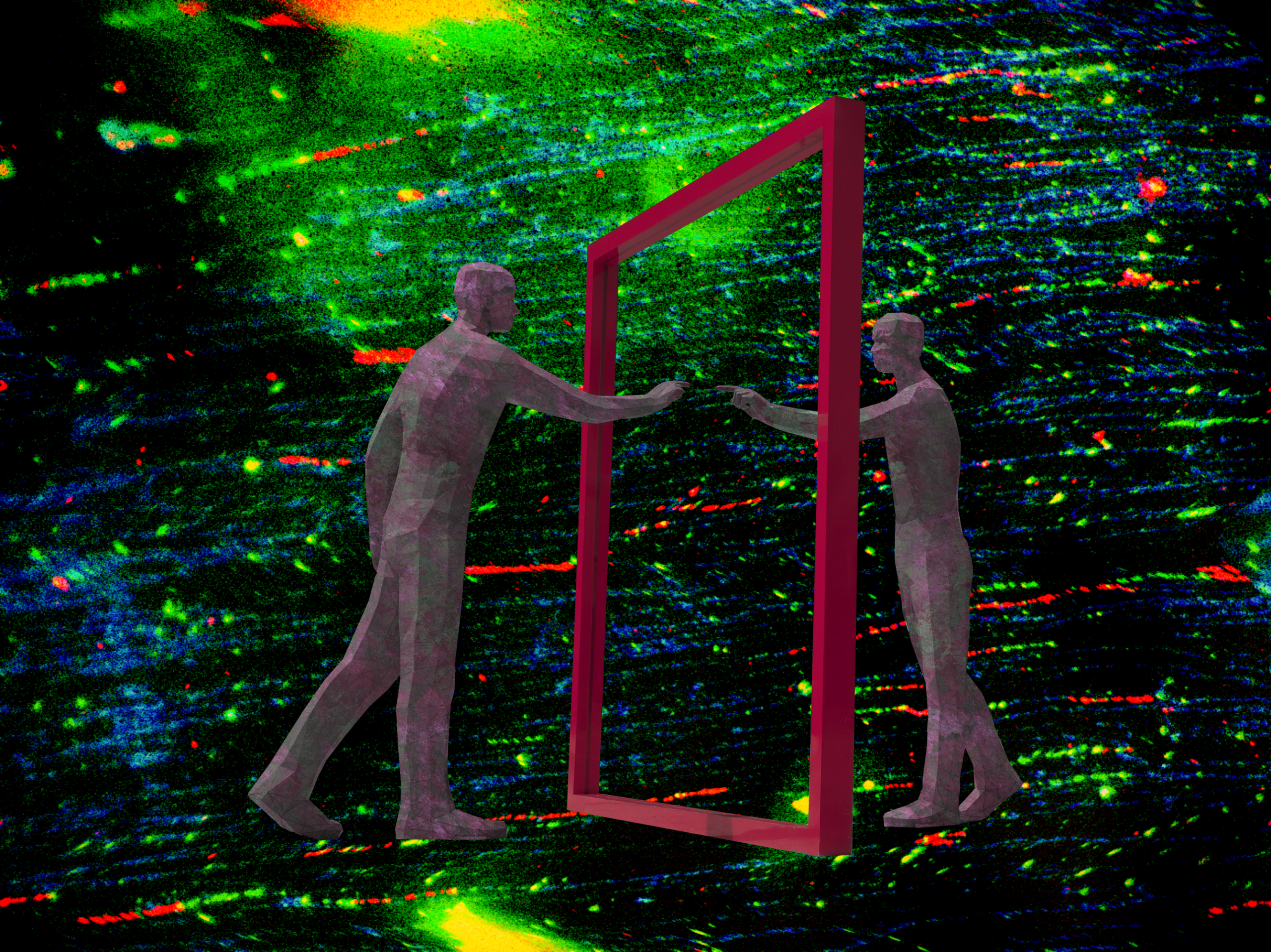
Image and words by Umayeer Milky.
These poems began in a season of exhaustion.
No one tells you how studying for qualifying exams rearranges your sense of time. It is a threshold that doesn’t look like one. While you’re inside it, the days stretch and repeat; once you leave, it contracts into something unreal, like a fever dream you can’t quite remember having. It lasts too long to be brief and not long enough to feel transformative. And yet, like any good experiment, it yields what you expected and something you didn’t know you were measuring. I was tired and procrastinating and I wanted to be productive. I was tragically depressed with homesickness and whimsically happy with memories of summer past. I was underprepared for the steady erosion of mental stamina and still enchanted by the promise of the work waiting beyond the exit sign.
I was thinking a lot about replication forks and maternal inheritance, about how a strand can serve as template and wound at the same time. In trying to master the language of molecular biology, in forcing myself to admire its supposed sterility, I began to hear its intimacy. Helicase unwinds. Polymerase extends. Ligase seals what was broken but still remembers.
In my dreamscapes, where forks blurred into the faces of people I love, the language began to loosen. Damage did not feel metaphorical; it felt procedural. A pause could mean everything. I noticed how often the cell waits without drama. How often repair is quiet. How a strand can begin again exactly where it left off. How in the small spaces something stalls and doesn’t collapse. The poems stayed there. In the interval between break and seal, where continuation is a promise for wholeness and citrus under the sun.
And in the intersection of all that, I realized forks are love stories.
The Manuscript
(in the style of T4T by Oliver Baez Bendorf)
I think she wanted to be copied, the way origins do.
My mother’s code felt like a pause mid-sentence. I mean
the fork never forks cleanly. We replicate with one eye closed.
When I say I inherit her, I mean repair tried and failed.
Sometimes a helicase keeps going even when the heart stalls.
Sometimes the past is an R-loop: coiled and hard to remove.
We ran out of dNTPs that summer. My brother wept
by the slide, a cell in G1 pretending not to divide.
I think replication must be a kind of reading. Or dreaming.
We lick citrus while she describes fork reversal in sunlight.
The man in the lab says damage is silent until it isn’t.
There’s a checkpoint in me that keeps activating around her.
When I touch my own face, I feel proofreading enzymes.
Tonight a polymerase starts again where the break left off.
Wait
(in the style of Everybody Has a Heartache: A Blues by Joy Harjo)
In a Petri dish in Boston, two yeast cells split too soon. They keep dividing with broken chromosomes because no one told them to wait. Their children are dead before they bud. The scientists watch them fail, and call it checkpoint deficient.
That gene they name RAD9. That protein says stop. It sees a tear in the DNA and whispers hold on. The other cells listen. They wait. They repair. They carry on because they paused
long enough to become whole again.
A kinase called ATM is a low bell ringing in a deep wood. When the chromosome breaks, its song gathers others like a hand reaching out in the dark. Its cousin, ATR, is the architect of the slow afternoon. It watches the replication fork lean and sway, stepping in to steady the loom before the thread can snap. Survival is the art of the long exhale.
Everybody has a heartache—
But the checkpoints are not gates. They are estuaries. A widening of salt and fresh where the current forgets which way is forward. The cell loosens its borders there. Chromatin opens like a lung in winter. Time beads along the strand; a rosary of pauses, warm with repair.
Somewhere in the nucleus, a scaffold of proteins gathers like winter birds. They make a temporary sky around the wound. The torn ends soften in their presence. A seam remembers it was once unbroken: not nostalgia, potentially possibility.
In the cytoplasm, molecules drift like plankton in a dark sea. Urgency is granular, particulate, suspended in a fluid that carries and carries. The cell folds. It unfolds. It tastes its own salts. It tests the tensile of its breath.
There is a geography to its delay. Coves of suspended mitosis, peninsulas of almost. Spindles poised but not yet pulling. Chromosomes hovering like twin moons who have not decided which tide to answer. Body a question mark, dappled with flickers of dawn light.
Everybody has a heartache—
In the dreamlands of the biological form, I see rooms made of membrane and weather. Places where I am not a verdict but a process. A spiral staircase of small corrections. Breaks that glow faintly, phosphorescent, asking to be rewritten. Renewal’s no trumpet but a quiet ligase closing the gap with transitional hands.
And somewhere in the litany of dancers in her dynamic skies, something in the cell leans toward itself. Permeability feels like dancing in the rain. To stay in the soft middle where damage becomes instruction, where the helix turns and turns and does not finish.
Everybody has a heartache—