
Isolate
written by Kate Jiang
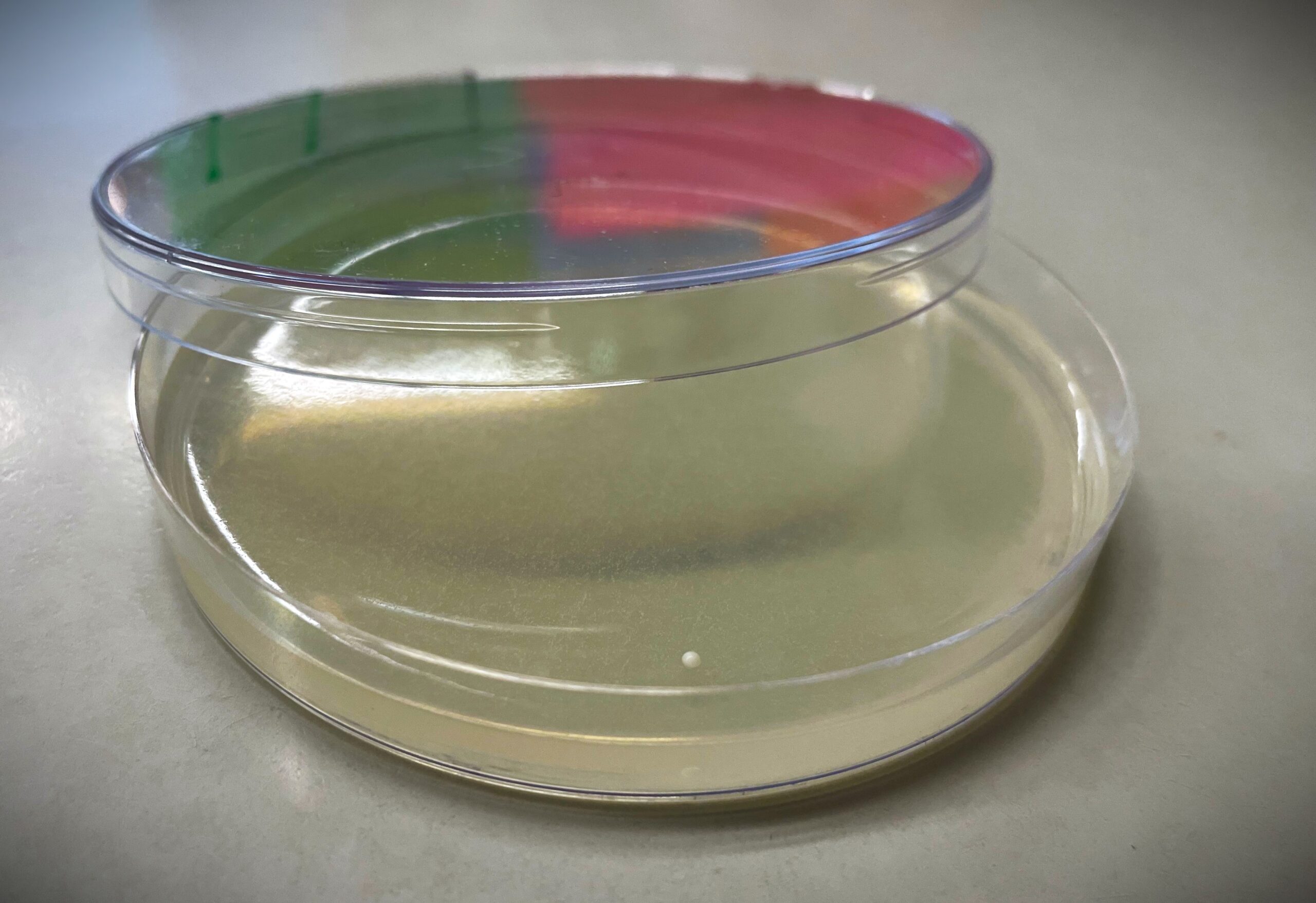
Photo by Kate Jiang
Content warning: This fictional work contains mention of death. Please refer to the Biochemistry Health and Wellness resource page if you need any support.
It was 8pm when David walked into the graduate student office. I raised my head from my desk at the sound of his footsteps.
“Are you the only one here?” He looked around, “Can’t believe you guys are heading home so early.”
“If someone other than me hears you talking like that, they’d probably assume you are a toxic PI.”
“Maybe they’re right.” David settled himself in the chair next to my desk. “So, what’s keeping you from heading out?”
I gestured at the Word document on my laptop. “The second version of my manuscript, which I’ll probably finish before you start reading the first draft.”
“That’s very likely.” David scratched the back of his head. “But seriously speaking, I am sorry about that, Erica. Poor time management hit me in the face again.”
I felt my expression soften. “It’s okay, I know you’ve been busy with all the grant applications and Jessie’s manuscript.” I remembered my lab mate, whose chair was being occupied by our supervisor at this very moment, talking about how she needed that publication to get her scholarship.
“Which is why,” announced David, “I’m working on a solution. Not the chemical kind, of course.”
As I rolled my eyes at his joke, I noticed he had his laptop in his hands. He carefully pushed Jessie’s stacks of notebooks and mountains of scratch papers away and settled his laptop on her desk. On the screen was a chat window, with several other Word and .pdf files opened behind the browser.
“It’s a Large Language Model that lets you train it with your own documents.” David presented it with the same enthusiasm as a conference speaker. “I’m feeding it my past proposals and manuscripts so that in the end it will write the grant the way I do. Don’t worry, the funding agency allows the use of generative AI these days.”
I frowned. “So, what I’m hearing is…you are trying to create an AI version of your own self?”
“Nuh-uh,” David waved his index finger at me. “I’m only training it with my scientific writings—it’s not like I’m giving it my diaries or something. All I’m trying to achieve is for it to learn how to write scientifically on my behalf. Perhaps even in my style, if you wish, though I don’t really think good scientific writing has any particular styles.”
“So, you don’t think you have any personal style in your science writing, but you are only feeding it your writing.” I pointed out.
David laughed. “Ironic, isn’t it? I thought about that as well. But it’s too late now, I’ve already spent way too much time fine-tuning this thing.”
“Is it working?”
“Sort of. I gave it a couple pieces of our preliminary data and asked for a short proposal abstract.” And that’s why you asked me for those data a couple days ago, I thought, as David tapped on the keyboard. “Here, have a look.”
Unlike the generative AI cliche I was familiar with, this abstract was impressively well-written. Had David sent it to the entire lab, we wouldn’t have suspected a thing. None of us would have figured out it wasn’t written by himself. “I think it helped that it only considers our lab’s publications and data. Maybe if I feed it some other lab’s peer-reviewed work, it would spew out better proposals, but that’s a problem for another day. Right now, I just want it to summarize the data the same way I would do—I don’t have much time.”
“Do you think this will be the future of science writing?”
“Possibly. Of course, there are a lot of issues with LLMs right now—they make up references and people use them to write fake reviews and so on. But the writing itself has always been straightforward. Unlike novels, poems or even non-fictions that require the creativities of humankinds, all you need to do in scientific writing is to get straight to the point as concisely as possible. Whatever we write are largely technical, and therefore, replaceable.”
I turned my head to face the manuscript draft that kept me here long after everyone else was gone. I never enjoyed writing—I’d rather run a protein purification well past midnight than sit in front of my computer, trying to connect the dots logically without having a mental breakdown. Letting AI do the job likely would’ve made my life much easier.
Even so, as David said the word “replaceable”, I felt like a hole cracked open in my chest.
“…Just please don’t accidentally feed it some of our drafts,” Finally I said, “I’m not ready to see my grammatical mistakes or your awkward jokes in your AI-generated proposal.”
David was never as serious as many of the other PIs I had met. In his words, he loved having “a little bit of fun” here and there. He once inserted “siRNA screens were despised by any sane geneticists” in Jessie’s draft and waited for her collaborators to point that out. Another time he put his pet bird in the acknowledgement section. The majority of his mischiefs never made it into the published version, for obvious reasons.
“Don’t you worry, Erica. I’m not training it with anything that’s premature. At least I hope so—I haven’t exactly been keeping track.”
“Also, I still think you’d better focus your energy on doing the real writing.”
“How brutal!”
And we both laughed.
* * *
A month after our late-night conversation, David passed away in a car accident.
* * *
The graduate students were promptly transferred to other supervisors, and the technicians and postdocs were hired elsewhere. As the most senior student, I was close enough to finishing my PhD that the department decided I didn’t need to transfer to another lab. One of my committee members was assigned as my supervisor on the book, but for the most part, I remained the only one in the lab, trying to wrap up my manuscript and my thesis.
Today the clock once again struck 8pm, and I was the only one on the floor. Only the noise of my laptop and the distant alarm of a broken lab freezer kept me company. No footsteps, no sight of my PI walking into the office, taking over my former labmate’s desk without invitation and exchanging friendly banter with me.
I walked past David’s old office. The “David Strix, Ph. D.” on his door had been scrapped away, waiting for the newest hire to move into my late professor’s base.
David gave us access to his little generative AI sandbox before he passed, and I gained approval from the department to use it to assist my manuscript writing. It was almost like David was editing my drafts, except he would never reply with things as nice as “Let me know if there’s any other specific things you’d like to refine!”
I placed my mug on the unoccupied desk next to me and sat back in my chair. The AI had returned its edits while I was making my tea in the kitchen.
In its true form, LLMs are layers upon layers of artificial neurons outputting their predictions based on the input. Nobody truly knew what was behind the interface in the black hole that absorbed and melted the information altogether and returned the answer in a fashion beyond its creator’s knowledge. To some extent, it was akin to an individual’s brain in that it was composed of billions of neurons, and that nobody other than oneself could predict how it functioned.
I thought, as I read through the edits, about how the information generated by David’s brain were embodied by the AI, forming a scientific identity of David Strix that hypothetically would communicate our research the same way David did, even after every single neuron of the scientist himself had returned to dust.
Would anyone ever be able to tell the difference, I wonder? Were our acts of scientific writing replaceable by machines?
I stopped at the subtitle of my next section.
Bacteria in Solitude: Single Isolate Express Lower Level of YFG Than Population
Single isolate. The AI made a joke. It made a pun in the subtitle—not something one would see unless specified in the prompt, or unless it was part of the training set.
I told him not to feed it the drafts. Like what he said, he clearly wasn’t keeping track.
In the middle of this quiet evening, I curled up in my chair, buried my head in between my arms, and wept.