
Connell Lecture Series: Dr. Steven (Siyuan) Wang
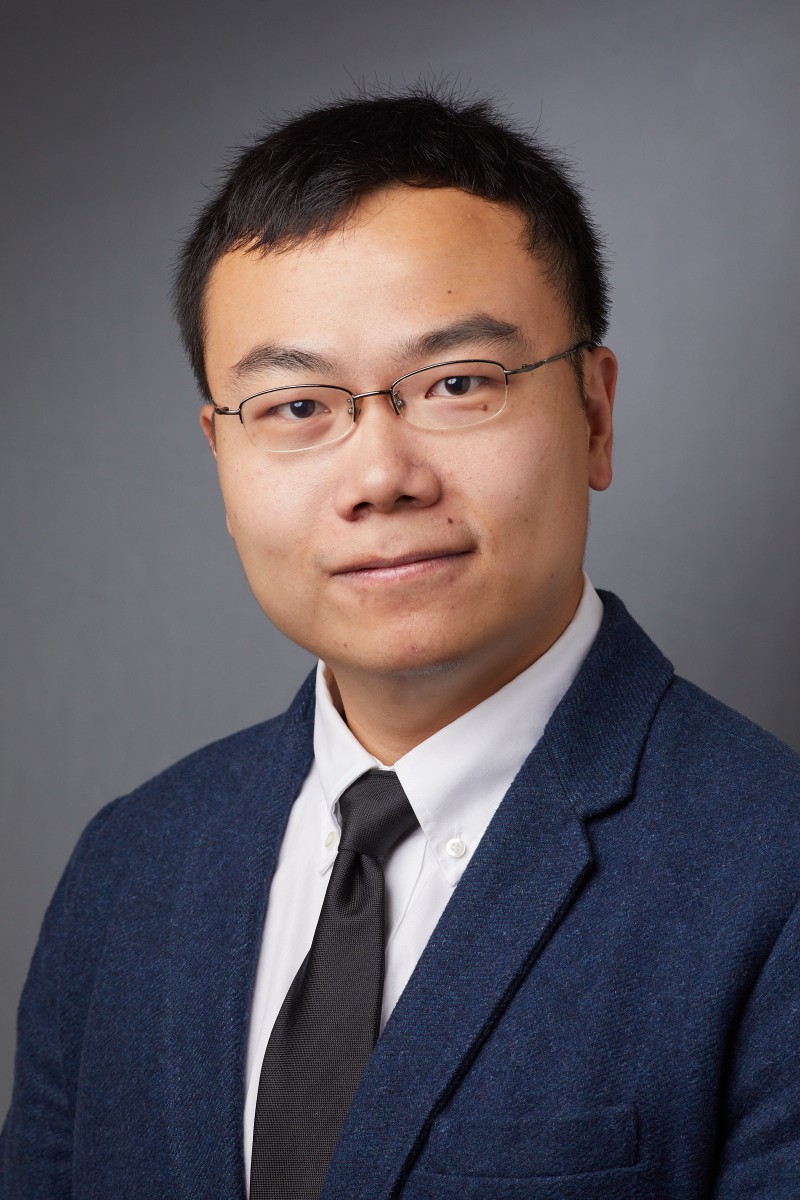
Written by Nour Bazzi
Interviewed by Nour Bazzi & Zoe Ang
A physicist who switched fields on a hunch at 25 and went on to build a way to see the genome fold inside a single cell, Yale’s Steven Wang talks about cooling off before chasing big ideas, the six-month rule for shelving a project, and why being the first person in history to know something still feels like magic.
Most of the scientists I’ve met are naturalists at heart. They want to understand a specific thing, a disease, a behavior, a molecule, and they’ll grab whatever tools get them there. Fewer scientists are instrument-makers first. For them the seeing comes before the seen. And every so often, someone working a little sideways from the mainstream builds a new way to look. Steven is one of those people.
Dr. Steven (Siyuan) Wang is an Associate Professor of Genetics and Cell Biology at Yale School of Medicine, where his lab studies what the genome looks like in three dimensions inside a single cell. Steven wasn’t always a 3D genomics person. He trained as a physicist before pivoting to molecular biology. As a graduate student at Princeton, he worked on bacterial cell mechanics. The jump happened at 25, when he read what he now calls the paper that started contemporary 3D genomics1. His reaction, however, wasn’t profound by his own account: “That looks cool. It involves another biopolymer, maybe more relevant to human health.” And just like that, he decided he’d switch fields for his postdoc.
I find it so interesting how casually it all seemed to begin. He wasn’t necessarily setting out to do something groundbreaking. I don’t think anyone decides in advance to become the person who changes a field. Instead, I think they become the sort of person who follows an interesting thread when they find it.
And that thread led him to Dr. Xiaowei Zhuang’s lab at Harvard.
At the time, the dominant way to study how DNA folds inside the nucleus was a method called Hi-C. In short, it measures how often different parts of the genome bump into each other, and from that you can infer something about how DNA is organized inside the nucleus. It was a revelation when it came out. It gave the field the first sequence-specific genome-wide map of 3D genome architecture.
But population-level methods, like Hi-C, have a limitation. The output describes a cell that doesn’t actually exist. What you get is a composite, a statistical smear where no single chromosome was ever visible.
And for a lot of questions, that’s perfectly reasonable. Sometimes an average really is what you need.
But the questions I’m interested in are a little different. I study development, and I want to understand how individual cells become what they become. Why does one cell become a gut cell while another becomes a neuron? How does the way their DNA is folded relate to those decisions? And when, exactly, does a cell become committed to a particular fate? I care about the cell-to-cell variation that population methods erase entirely. And for those questions, the average is misleading. It shows you a smooth, consensus picture of something that is, in reality, heterogeneous and dynamic and unique.
To understand development, you need to look at single cells. And to look at single cells, you need a different kind of tool. Which brings me back to Steven’s story.
In 2016, as a postdoc, his answer was to build a new way of looking. His method ran sequential rounds of fluorescent probes through the nucleus, each one lighting up a single genomic region in turn. Image it, bleach the fluorescence, move to the next region, image again, then stitch the positions together. What comes out the other end is a three-dimensional map of one chromosome, in one cell.
It was published in Science2, and it shifted the question from whether these structures existed to what they actually looked like in real 3D (no inference needed), chromosome by chromosome, cell by cell.
That’s the question I’m trying to answer. And the fact that I can try to answer it at all is, in no small part, because of the tool Steven built.
Below is a record of our conversation.
Nour: What kind of scientist were you at 25 compared to right now?
Steven: When I was younger, as soon as I had an exciting new idea, I’d rush to try it right away. Through my earlier career that cycle of excitement followed by failure repeated quite a bit. Nowadays I’m more cautious. When I have an exciting idea, I’m really pumped about, I intentionally wait a couple of days to cool down, then come back and ask: are there potential pitfalls? Do I need a couple of miracles to happen for this to work, and what would I need to do to test those? I try to be intentionally a little more pessimistic – to think carefully before pulling the trigger – because even a small test project takes time. I learned that the hard way. It’s better to plan more and think deeper before riding the adrenaline wave.
Zoe: When did you first feel like you were no longer just training, but actually thinking for yourself, developing your own questions, and leading your own projects?
Steven: I think it was sometime in grad school. I remember telling someone I wished I could reach a point where I had an overarching vision of how a project could mature into something full-scale.
What really helped me make that leap was a practice I developed in grad school. Every week I’d get alerts for new issues of Science, Nature, and similar journals, and I’d read the abstracts – so I knew the conclusions upfront – but before reading the paper, I’d try to imagine how each conclusion was achieved. What experiments would be needed? What techniques could answer the question? What controls would be required to rule out artifacts? Then I’d compare my thinking with what the authors actually did. For some conclusions I had no idea how they got there given my limited knowledge, but when I read the paper and saw how they did it, I remembered it so much better because I’d had to actively think about it first.
This practice really helped train my overarching scientific thinking, so that later, in my own projects, I could do the same thing – think through what experiments to run, what the possibilities are, and what controls are needed to build a rigorous story. I often tell my students to try this. It’s a great mental exercise for developing scholarly maturity because, through a PhD, it’s not just about learning to do experiments and analyze data – half the training is about learning to think like a scientist.
Nour: How do you decide what problems are worth years of your life?
Steven: In terms of choosing what to devote my own effort to, there are different philosophies. Personally, what excites me most is new technology development – coming up with new approaches and applying them to new scientific questions. Maybe it goes back to how we formed our first impressions of scientists as kids, seeing cartoons where the scientist builds a machine and uses it to do something. I’m not saying this is the right philosophy for everyone, but it’s mine.
For technology development, impact comes from being either first-in-class or best-in-class. There will always be new technologies, so once you invent something, you also try to stay at the front of development. The type of impact can also vary. It could be a meaningful quantitative improvement – a twofold gain in a hot, widely-used area like spatial transcriptomics or 3D genomics – or it could be a breakthrough in a very niche area that’s ten times better than anything else, or that makes something previously impossible now possible. Either breadth of impact or depth of impact can constitute high impact.
But ultimately, one of my key drives for doing science is feeling proud of the work and feeling that it makes a real difference to the field. That’s why I aim for first-in-class or best-in-class development.
Zoe: When you hit a roadblock, how do you distinguish between a project that isn’t going anywhere versus one where you just need more patience?
Steven: I’ve definitely learned that the hard way. There were cases where I dwelt on a project for two and a half years and then finally gave it up. There’s this concept called the sunk cost fallacy: the more you invest in something, the stronger the pull to keep going, because giving up feels like wasting everything you put in.
For me, these days, for a new idea that requires a miracle or two to work, I give it three months and look for a good sign that it might work. Then at the six-month mark, I ask: do I know definitively this is going to work? If I still don’t know by that point – even if there are clear things left to try – I’ll shelf the project and start testing something else. We’re never short on ideas. There’s always “one more thing you can do,” and you can end up spending years before discovering there’s a fundamental limit and it simply doesn’t work.
Shelving a project can also be valuable in itself. Sometimes later you come up with a better strategy. In fact, we’re currently revisiting something we shelved two or three years ago because I just came up with a new idea – I tested it myself on the bench, and it looks like it’s going to work this time.
So: set a specific time limit, and if you exceed it, move on to the next thing.
Nour: Did you almost ever leave academia? What kept you in?
Steven: The thing that helped most psychologically was letting go of the idea that I had to stay in academia. I told myself: I could go to industry if it doesn’t work out, and industry has its own real perks. Once I released that grip – once I accepted that it would work out one way or another – the pressure on any single outcome went away. That thought was genuinely liberating.
When people talk about the advantages of staying in academia, the traditional answer is scientific freedom, especially as a PI. You drive your own research. It’s exciting to see your own ideas flourish.
But there is a deeper, more intrinsic reason, shared by many PIs. That reason is the value to humanity.
There is a profound societal value to this work. Everything you discover, as long as it can be published, is new. In all of human history, no one has ever discovered it before, and no one can rediscover it – you are the very first. That is pushing the frontier of human knowledge and human understanding of nature. Compared to many other professions, that is a profoundly meaningful thing to do.
I now talk to students about this level of value regularly. Even if a student is just trying to get a degree and move on, I want them to know that their work carries this weight – that many people recognize it, even if few say it aloud.
Scientific freedom is a second reason. And a third is a certain pride: knowing that in this area, right now, you are among the very best in the world at this particular thing. There’s something really fulfilling in that.
Nour: What part of science still feels magical to you?
Steven: A magical thing intrinsic to science is that there are always things outside your imagination – pleasant surprises you never expected. Of course, there are unpleasant surprises too, things that don’t work as intended, but sometimes there are genuinely delightful ones. Those kinds of “aha” moments are what make this magical.
Citations:
1. Lieberman-Aiden E, van Berkum NL, Williams L, et al. Comprehensive mapping of long-range interactions reveals folding principles of the human genome. Science. 2009;326(5950):289-293.
2. Wang S, Su JH, Beliveau BJ, et al. Spatial organization of chromatin domains and compartments in single chromosomes. Science. 2016;353(6299):598-602.